
Quick Verdict (TL;DR)
Traffic Rider in 2025 remains a surprisingly enduring motorcycle arcade game. It’s not the most advanced or realistic bike sim available, but for quick, satisfying bursts of gameplay, it continues to deliver. If you enjoy fast-paced action, responsive handling, and a skill-based loop that doesn’t demand long play sessions, Traffic Rider still earns its place on modern devices — as long as you’re willing to deal with frequent ads and a monetization model that can feel pushy at times. Below is our full, straightforward review.
What Is Traffic Rider? A Brief Overview
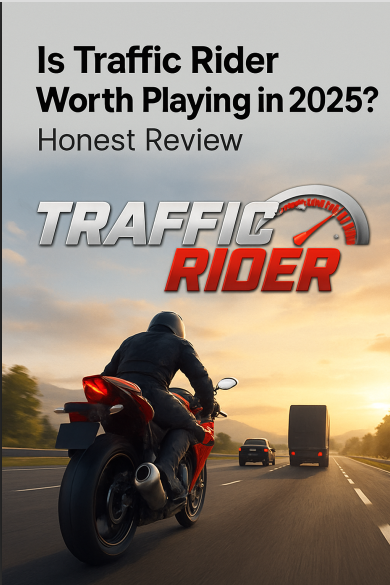
Traffic Rider is an arcade motorcycle game focused on weaving through traffic at high speeds, earning cash, and upgrading bikes. Launched years ago, it became popular for its first-person perspective and tight controls. In 2025, the formula is unchanged — quick runs, simple goals, and an addictive progression loop.
History and Evolution (2014–2025)
Released in the mid-2010s, Traffic Rider gained traction due to its immersive cockpit view and smooth handling. Over the years, developers introduced graphical updates, more bikes, and multiple monetization models (ads, rewarded videos, in-app purchases). By 2025, the game still looks modern enough, although certain UI elements show leftover design from earlier versions.
Gameplay: Core Mechanics & Modes
At its core, Traffic Rider revolves around timing and reflexes — when to speed up, when to brake, and when to perform risky overtakes. Controls are snappy, lane changes feel immediate, and the reward loop is simple: earn money, upgrade bikes, and unlock new environments or missions.
Endless Mode vs. Career Mode
Endless Mode caters to high-score enthusiasts aiming to survive longer stretches of chaotic traffic. Career Mode offers mission-based progression with structured objectives. Both modes serve different player types well, and trying each one is recommended before spending money.
Controls and Learning Curve
Players can tilt or tap to steer, with buttons for braking and nitro. The controls are easy to grasp, yet precise enough to reward skill. Most players will get comfortable within the first 10–20 minutes, though advanced play involves mastering nitro timing, braking techniques, and close-pass mechanics.
Graphics, Audio & Presentation in 2025
For a mobile arcade racer, Traffic Rider’s visuals in 2025 are solid. Environments feature sharper textures and improved lighting, though it doesn’t aim for lifelike realism. The visual focus is clarity — what you need to see, you see quickly.
Visual Upgrades and Performance
Bike models appear more refined, and particle effects like dust and sparks have been upgraded. High-end devices offer smooth frame rates; older phones may require reduced settings to avoid dips or UI stutter.
Sound Design & Music
Audio remains one of Traffic Rider’s strengths. Engine sounds, tire screeches, and collisions are clean and impactful. The soundtrack is energetic without distracting from gameplay, and sound cues can help with timing nitro boosts or anticipating hazards.
Monetization: Ads, IAPs, and Player Experience
Monetization is the biggest potential deal-breaker. Traffic Rider uses interstitial ads, rewarded videos, cosmetic purchases, and paid upgrades. This system influences the overall flow more than anything else.
Advertising Frequency & Intrusiveness
Rewarded ads (for double rewards or extra lives) are reasonable, but interstitials appearing between runs can feel repetitive — especially during short play sessions. Buying the ad-free option fixes this, though it may be pricey depending on your region.
Microtransactions: Fair or Pushy?
Players can buy coins, premium bikes, and limited bundles. While purchases aren’t mandatory, they accelerate progression significantly. Competitive players and completists may feel pushed toward spending. Fortunately, skill still plays a major role in scoring well.
Device Compatibility & Technical Stability
The game runs on a wide range of iOS and Android devices. In 2025, support remains broad, though performance varies depending on hardware.
Performance on Low-end vs. High-end Devices
High-end devices deliver smooth performance, crisp textures, and fast loading. Older phones may see occasional frame drops, longer loading times, or UI delay — but the game remains playable.
Battery, Heating, and Data Use
Fast-paced gameplay drains battery quickly. Long sessions may increase device temperature. Data usage is light, mostly tied to ads and occasional content downloads. Some features may require online access.
Longevity: Replayability & Community
Traffic Rider thrives on short, addicting gameplay loops. Daily missions, unlockable bikes, and leaderboard chasing provide ongoing motivation. The community isn’t massive, but the dedicated players who remain are loyal.
Updates, Events & Developer Support
Updates have slowed since the game’s peak, but seasonal events, new bikes, and cosmetic items still appear periodically. Major bugs are usually addressed promptly.
Community, Mods, and Competitive Play
Modding isn’t common due to mobile limitations. Competition mainly happens on leaderboards and social sharing. Engaging in community groups can provide valuable strategies and bike recommendations.
Accessibility & Learning Aids
Accessibility is basic but serviceable. Sensitivity settings, alternative control schemes, and tutorials make the entry barrier low. More specialized accessibility options vary by platform.
Control Customization & Assist Options
Players can switch control styles and use optional brake assistance in some versions. These tools help newcomers adapt more quickly.
Comparisons: Traffic Rider vs Competing Titles
Mobile racing in 2025 is crowded with both realistic sims and arcade racers. Traffic Rider isn’t a deep simulation, but it outshines many lane-based endless racers thanks to its first-person perspective and smooth handling.
Best Alternatives in 2025
For realism: look toward titles emphasizing physics and open-world riding.
For pure arcade fun: newer endless racers offer similar thrills with less intrusive ads.
Still, few replicate the “on-bike” immersion that Traffic Rider provides.
Who Should Play Traffic Rider in 2025?
Casual players will appreciate short, adrenaline-filled sessions.
Completionists and competitive players will enjoy the high skill ceiling but should expect grinding or optional spending.
Casual Riders
Short runs, rewarded ads, and steady upgrades make this game ideal for brief daily sessions.
Completionists & Competitive Players
You may face grind-heavy missions or paywalls if you want everything quickly. The game’s top-tier bikes require either patience or investment.
Our Final Verdict: Is It Worth Downloading?
Yes — with some conditions. Traffic Rider remains a polished, engaging arcade motorcycle game. It’s fun, fast, and addictive. However, heavy advertising and aggressive monetization may frustrate some players. If you prefer deep simulations or open-world riders, look elsewhere. But for quick, high-speed bursts, it’s a great choice.
Tips & Tricks: Get the Most Out of Traffic Rider
Beginner Tips
- Master lane discipline: Don’t over-weave — choose openings and commit.
- Nitro timing: Best used after clean overtakes or to escape tight traffic.
- Daily missions: These provide consistent, valuable rewards.
Advanced Techniques
- Brake + Nitro Combo: A brief brake tap before nitro stabilizes high-speed passes.
- Slipstreaming: Riding behind larger vehicles grants subtle speed boosts.
- Bike Selection: Balance speed and handling — ultra-fast bikes can be unwieldy.
Conclusion
Traffic Rider remains a reliable, exciting arcade motorcycle game in 2025. Its quick sessions, responsive controls, and satisfying audio feedback keep it entertaining. Monetization is its biggest flaw, but if you can ignore ads or purchase the ad-free version, the game becomes an excellent pick for both casual and competitive players. It doesn’t redefine the genre, but it continues to excel at what it set out to do: provide fast, enjoyable, bite-sized racing fun.