
Introduction
We love a good challenge — and Traffic Rider’s Endless Mode is one of those addictive, hair-raising challenges that tests reflexes, planning, and patience. In this guide, we’ll walk you through ten pro-level tips that will help you survive longer, score higher, and feel like a true master on the asphalt. We’ll break down mechanics, setup, nitrous strategy, traffic prediction, and the soft skills — yes, your mindset — that turn occasional runs into consistent high scores. Ready to level up? Let’s ride.
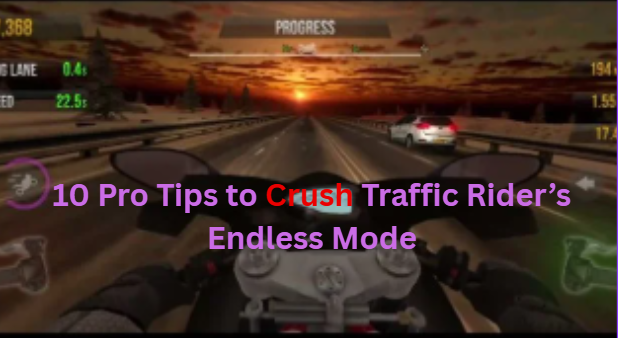
Understanding Endless Mode Basics
Core Mechanics
Endless Mode strips the campaign’s narrative and focuses purely on survival and score accumulation. You control acceleration, braking, lane changes, and nitrous. Collisions slow you down dramatically or end the run, so staying alive is the priority. Distance, collected coins, and sometimes multipliers or objectives determine your score — everything compounds, so small gains add up.
Objectives & Scoring
Unlike short missions, Endless Mode rewards steady, repeatable performance. Distance is king: the farther we go, the higher the base score. Coins and objectives (if active) add to the total. Some runs will favor coin-hunting for upgrades; others prioritize long-distance endurance. Understanding which route gives the best return for your play style is crucial.
Tip 1: Choose the Right Bike & Upgrade Path
Priority Upgrades
Not every bike is made equal. For Endless Mode, we prefer a bike that balances top speed, handling, and nitrous efficiency. Early on, invest upgrades in this order: handling (so you don’t clip traffic), nitrous capacity (for controlled bursts), then engine (for top speed).
Why handling first? Because being fast is useless if we’re constantly crashing. Consider bikes with nimble steering and good acceleration rather than raw top speed alone.
Tip 2: Master Braking & Throttle Control
One of the biggest differences between average runs and pro runs is throttle discipline. Instead of blasting full throttle and praying, we feather the gas, brake lightly into crowded areas, and use tiny throttle adjustments to maintain momentum.
Braking isn’t always about slowing down — it’s about timing. A soft tap of brake can settle the bike and make lane changes safer. Practice maintaining a moderate speed through dense traffic rather than attempting to blast through at top speed.
Tip 3: Nitrous Timing & Management
Nitrous is a double-edged sword. Used right, it gives big distance jumps and helps escape tight spots. Used wrong, it throws you into traffic or wastes capacity.
Our rules: never use nitro when you’re boxed in by traffic; only deploy it when you have a clear lane for at least a few seconds. Save one or two short bursts for emergencies (a sudden truck or an unexpected slow car).
For many players, the best strategy is short, controlled bursts rather than a single long blast.
When to Nitro
Ideal moments: straight stretches after a cleared gap, right after overtaking a cluster of cars, or to quickly grab a coin line before it closes. Avoid using nitrous when sharp lane changes are required immediately after activation.
If you’re approaching heavy traffic, force yourself to wait for the gap. Patience here repays you with longer runs.
Tip 4: Predict Traffic & Maintain Lane Discipline
Reading AI Patterns
Traffic Rider AI is surprisingly consistent. Small vehicles tend to keep speed or make slow lane changes; trucks and buses are slow-moving obstacles.
Over time we can learn patterns: a single slow car followed by a gap usually means another car will follow.
Prefer middle lanes for more escape options, but be ready to shift — lane discipline means staying predictable while being ready to move.
If you zigzag randomly, you’ll bite the dust sooner.
Tip 5: Camera Angles & Sensitivity Settings
Your control settings change everything. Try slightly higher sensitivity if you’re comfortable — it reduces the need for large steering motions.
Camera angle matters too: a wide, slightly zoomed-out view gives better reaction time; a close view looks cinematic but reduces your ability to plan.
Experiment until you find a balance that lets you spot gaps two or three vehicles ahead. Small tweaks here can shave reaction time and prevent crashes.
Tip 6: Coin & Objective Prioritization
Coins are tempting, but every sideways swerve to grab them introduces risk. Decide your priorities before each run: are you farming coins to buy upgrades, or chasing a distance record?
If the former, target low-risk coin lines (those that require minimal lane changes). If the latter, avoid coin-heavy detours.
We often employ a hybrid: collect easy coins and skip risky patterns unless the payoff is clearly worth it.
Risk vs Reward
Ask yourself: will this coin gain 2–5% to my upgrade progress, or will it cost me a run?
If the coin’s value is small compared to the progress you’ll lose by failing, skip it.
We learn to make split-second cost-benefit assessments — and over time, this saves entire runs.
Tip 7: Practice Different Scenarios (Night, Weather, Heavy Traffic)
Different conditions require slightly different habits.
Night mode reduces visibility: reduce speed slightly and focus on lane discipline.
Rain or wet road effects (if present) demand smoother inputs.
Heavy traffic simulations are the best practice drills — they teach us to survive close calls and read subtle AI moves.
Dedicate practice sessions to each scenario for 10–15 minutes to build muscle memory.
Tip 8: Smooth Steering & Micro-Adjustments
Small corrections beat dramatic swerves. When we make big steering inputs, recovery often causes overcorrection and collision.
Train yourself to perform micro-adjustments — tiny nudges that keep you centered or slip you into a gap without ever losing composure.
Smooth control also helps when using nitrous; a sudden swerve while nitro is active is often fatal.
Avoiding Overcorrection
If you start to oversteer, counter-steer gently and reduce throttle.
Don’t panic-brake; panic actions lead to unpredictable behavior.
Instead, let off the gas slightly and make a measured correction.
This cool-headed approach turns near-misses into safe passes.
Tip 9: Advanced Overtaking Techniques
Overtaking is more than pushing into a lane — it’s timing, predicting the other vehicle’s reaction, and sometimes playing subtle psychological games (like a short tap on the brake to invite a lane change).
Use the slipstream effect: if you can tailgate a vehicle safely, you can use it to build momentum and slingshot around when an opening appears.
Look for patterns — some drivers in the game drift into the shoulder briefly or slow at consistent intervals. Exploit those windows.
Slipstream & Gap Exploitation
Slipstreaming behind a slower vehicle reduces perceived speed difference and can create opportunities.
The trick is to stay patient and let the other vehicle move—not forcing it.
This takes practice but becomes a major scoring advantage.
Tip 10: Mental Game, Session Planning & Recovery
Gaming endurance matters. We recommend short, focused sessions of 15–25 minutes rather than marathon plays that fatigue the hands and eyes.
Warm up with a 5-minute practice run, then attempt record runs when fresh.
When you make mistakes, analyze what went wrong: was it bad timing, a wrong sensitivity setting, or poor risk assessment?
Recovery matters too: breathe, stretch, and come back with a clear head.
Often your best run will come when you’re calm, not when you’re chasing a previous mistake.
Troubleshooting Common Pitfalls
- Constant crashing: Reduce sensitivity and upgrade handling. Practice micro-adjustments.
- Nitro deaths: Save nitrous for clear stretches and use short bursts.
- Poor distance despite high speed: You’re likely taking too many risky coin runs; focus on steady lane discipline.
- Panic braking: Slow down your pace of play; practice calm corrective inputs.
Conclusion
We’ve covered the most impactful habits and strategies to crush Endless Mode: choosing the right bike, prioritizing handling upgrades, mastering nitrous, reading traffic, and training the mental game.
The secret isn’t one flashy trick — it’s consistent, deliberate practice and smart risk management.
Follow these tips, be patient, measure progress, and you’ll see your scores climb.